Voyager is one light-day away. One-way delivery: 24 hours.
NASA’s 1977 probe crossed a distance milestone on 18 November. Its radio signal now needs a full day to reach Earth.
Sources checked 20 Nov 2026 · AI-assisted · Revision 4
Get this: Separate a confirmed distance milestone from the unresolved problem with Voyager’s data.
What happened
Voyager 1 became the first human-made object to reach one light-day from Earth on 18 November. That is about 25.9 billion kilometres: the distance light travels in 24 hours. NASA confirmed it using the probe’s carrier signal and calculated path.
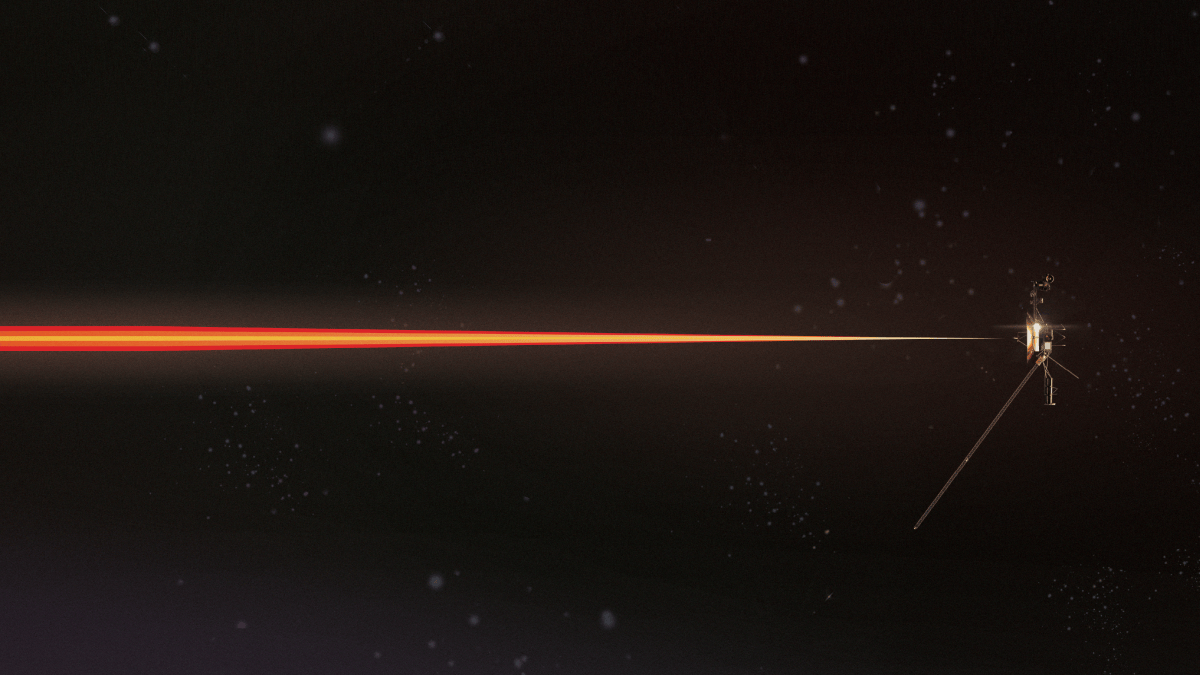
Artist’s illustration of Voyager 1 communicating across space. Its radio signals now take a full day to reach Earth. Illustration published 19 November 2026; creation date not stated. NASA/JPL-Caltech. Published 19 Nov 2026. Source and credit
Why it matters
A radio command takes one day to arrive, and a reply needs another day to return. The probe launched in 1977 and communicates from interstellar space. Space has invented the world’s least impatient group chat.
The useful bit
NASA says Voyager 1 has not returned science or engineering data since 14 November, although its carrier signal remains. The distance milestone is confirmed, but the data problem is unresolved. An achievement and a working science feed are different claims.
MAKE IT MAKE SENSE
Two things can be true at once.
Voyager reached an extraordinary distance, and it has a data problem. The signal and calculated path support the distance claim. They do not show that the science feed is working again. Keeping those claims separate lets you understand the achievement without quietly deleting the unresolved problem.
THINK IT THROUGH
NASA can still detect Voyager’s carrier signal. What does this report support?
Pick an answer in your head. Open it to see the reasoning.
AA detectable signal means the science feed is working again.
Look at the difference.
A detectable carrier signal is not the same as receiving science or engineering data. NASA says the data problem remains unresolved.
CThe data fault means the distance cannot be confirmed.
Look at the difference.
The story describes evidence for the distance even while science or engineering data are missing. One claim can be supported while another problem remains open.